Territory Energy Link: Why Tennant Creek's Central Role is Non-Negotiable

BRC_Graphic_divider

Tennant Creek, NT – Monday 28 July 2025 - The Barkly Regional Council today issued a strong call to action, urging the Northern Territory Government, Infrastructure Australia, and all stakeholders to reinstate Tennant Creek as a core component of the Territory Energy Link (TEL) corridor. The Council asserts that bypassing Tennant Creek risks squandering decades of strategic planning and undermining critical regional development.


"Our region is not only poised to support the Territory economy but is fast becoming an engine room for the Nation," said Barkly Regional Council Mayor, Sid Vashist  "As the Territory Energy Link corridor moves into its feasibility phase, it’s critical we ensure Tennant Creek remains central to this vision."


Originally conceptualised as the Tennant Creek to Darwin Infrastructure Corridor, the TEL's focus has shifted to run from near Elliott to the Middle Arm Precinct in Darwin. While the proposed 670km multi-user, multi-asset infrastructure corridor is visionary, enabling gas, water, optical fibre, hydrogen, and future-facing services, the decision to bypass Tennant Creek raises significant concerns.


Why Tennant Creek Must Not Be Left Out:


·        Logical and Historical Hub: Tennant Creek has long been envisioned as a mines and energy hub, connecting Australia’s north-south (Adelaide–Darwin) and east-west (Queensland–NT–WA) freight and energy corridors. It already hosts critical infrastructure, including rail, roads, and communications, making it uniquely positioned to support a hub-and-spoke model for resource distribution across Northern Australia.


·        Critical Intersections: Tennant Creek connects the Stuart Highway (north-south) with the Barkly Highway (east-west), two of Australia's most vital freight routes. Excluding Tennant Creek risks disconnecting this national infrastructure artery and losing future east-west integration, such as the Mt Isa–Tennant Creek rail proposal and Beetaloo to QLD energy export pathways.


·        Surge in Investment Confidence: Tennant Creek is currently experiencing significant investment from industry, exploration companies, government, and social infrastructure providers. Diverting the TEL now sends a negative signal, risking confidence, reducing private capital flow, and undermining long-term commitments in education, health, housing, and community services.


·        Essential Service Hub for Energy & Resource Projects: The Beetaloo Sub Basin and surrounding resource zones will require a central logistics, service, and maintenance hub. Tennant Creek offers the workforce potential, transport accessibility, and Indigenous partnerships to support this, and is better positioned to provide foundational infrastructure for hydrogen, gas, and minerals processing and services.


·        Cost vs. Opportunity: While realigning to Tennant Creek may appear to carry short-term cost implications, the long-term benefits – including economic resilience, diversification, private sector leverage, and Indigenous employment – offer exponential returns. The Council warns against repeating past mistakes of underinvesting in enabling infrastructure across regional Australia.


The Barkly Regional Council urges the Northern Territory Government, Infrastructure Australia, and all levels of industry, investors, Traditional Owners, and the private sector to have their say.


"Let us not lose the futurist and strategic vision of this corridor," the Council stated. "This is a once-in-a-century opportunity to shape our Territory’s infrastructure blueprint. Tennant Creek should not just be near this corridor — it must be part of it. Let’s not cut out the heart of the Centre. Let’s back the Barkly."


Specifically, the Council is calling for:


·        Reinstatement of Tennant Creek in the core alignment of the Territory Energy Link.

·        Detailed assessment of a Tennant Creek–Elliott connection within the feasibility process.

·        Modelling of Tennant Creek as a hub-and-spoke node, supporting regional growth,

  workforce training, and service delivery.

·        Transparent community and stakeholder consultation to avoid decision-making that lacks

  Barkly representation.


***

About Barkly Regional Council: Barkly Regional Council is responsible for fostering sustainable development and delivering essential services to over 8,000 residents across 322,713 square kilometres in the Northern Territory.


Contact: Lis Clough Admin & Media Officer, Barkly Regional Council

Lis.clough@barkly.nt.gov.au Tel: 0408 139 908

June 25, 2026
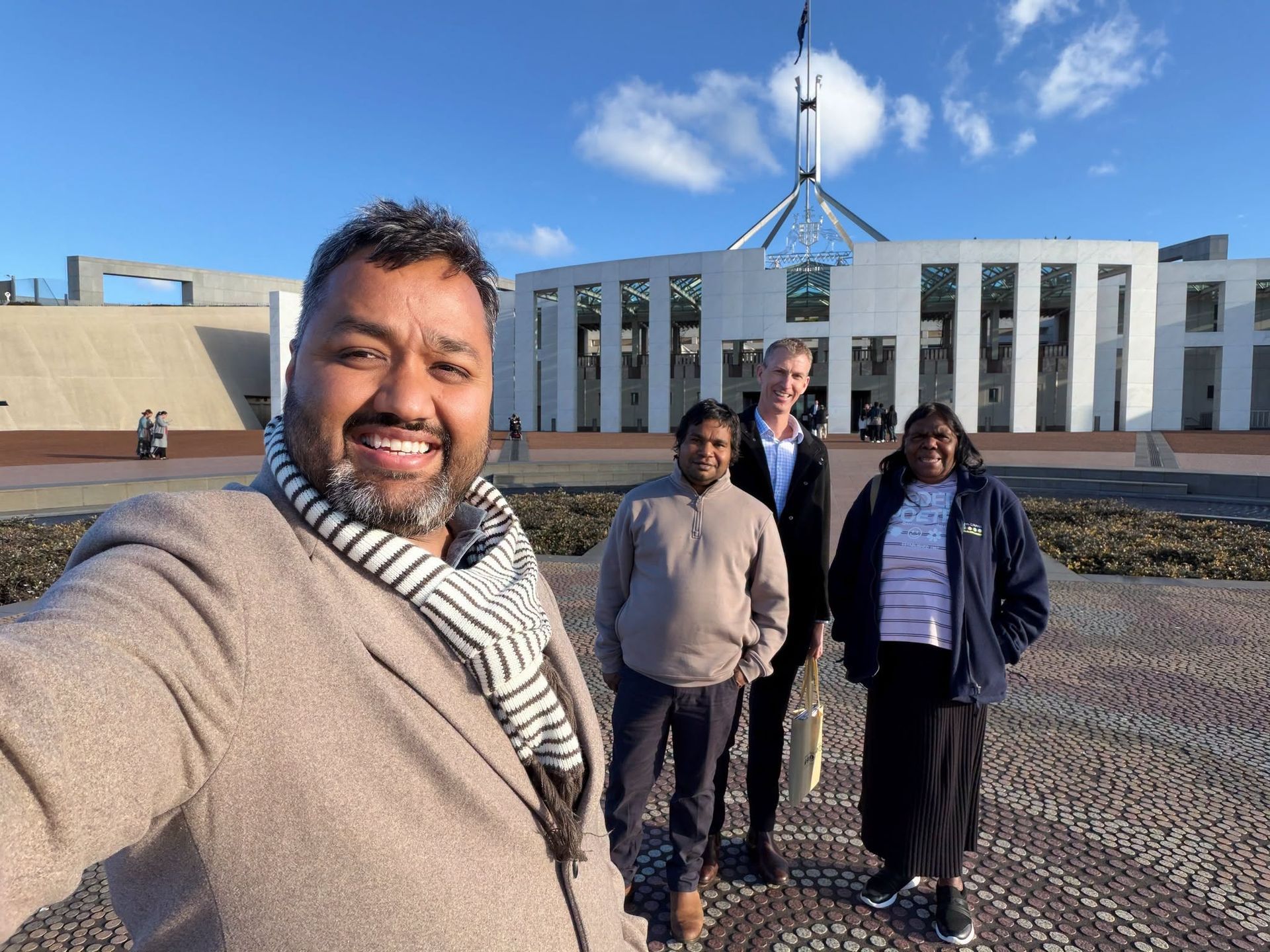
25 June 2026 A Parliamentary Inquiry has heard the Barkly Regional Council’s (BRC) vast expanse, isolation, high costs, and repeated underfunding have left remote community infrastructure on the brink of collapse and that an urgent funding injection is required to stabilise the situation. A BRC delegation has today appeared before the Parliamentary Inquiry into Local Government Funding and Fiscal Sustainability which is examining the financial relationship between local government and other levels of government in Australia. Following the Inquiry on Thursday, Mayor Sid Vashist, Deputy Mayor Valda Shannon, Councillor Ben Neade and CEO Peter Harder publicly called on the Australian Government to provide an urgent funding injection to ensure communities have safety, security and sustainability into the future. CEO Peter Harder said despite having effective operational systems in place, the BRC had limited capacity to maintain its current assets across its footprint due to minimal funding and high costs. “Our plant and equipment, used almost daily to deliver community services, has an average age of 15 20 years,” he said. “Maintenance costs are escalating to unsustainable levels and there is no pathway forward to replace the assets. “Buildings in our communities have deteriorated to the point of closure, and there’s no funding to upgrade these assets to keep pace with safety and legislative requirements. “Further, roads funding supports approximately one third of the required works program however because the BRC is unable to maintain the other two thirds or our roads, replacement costs escalate by four or more times.” Mr Harder said the BRC, which covers an area of 322,000 square kilometres, is unable to raise enough income to meet expenses. “For a start, the revenue from rates represents only 20 per cent of expenses, and it is difficult to see any drastic shift in that ratio as our rates are already on the high side of average,” he said. “We cannot set the rates for pastoral or mining tenements, and this means the BRC must pick up the shortfall for wear and tear on our roads and facilities, which adds to our financial burden. “A lack of significant tourism in the region limits our leveraging opportunities; overcrowded houses add to the strain on our services; and the majority of our residents are unable or unwilling to pay user fees and charges such as fines or dog registrations.” Mr Harder said a BRC delegation is meeting with Federal Ministers in Canberra to appeal for funding to implement an asset management plan for its five remote communities - Elliott, Alpurrurulam, Ampilatwatja, Arlparra, and Wutunugurra. “We want to work with the Australian Government to reform infrastructure and services in the Barkly’s remote communities towards addressing many of the key targets of the National Agreement on Closing the Gap,” he said. “We know that equitable environments lead to better outcomes across the board because it means communities can be better equipped to manage health, housing, education, and employment needs. “These are building blocks of thriving, sustainable societies and access to adequate funding to be able to create safe, functional, resilient, socially cohesive communities is not a privilege. It is a moral obligation of governments.” Media enquiries: media@barkly.nt.gov.au
May 22, 2026
Barky Regional Council seeks community feedback on Draft Regional Plan 2026-27 Barkly Regional Council invites feedback from all community members on our Draft Regional Plan 2026–2027. Your input helps shape the future of our region. To access the document, please click on link below. BRC Regional Plan 2026-27 (Draft) for Public Consultation Feedback can be submitted by close of business Thursday 18 June 2026 via email: feedback@barkly.nt.gov.au.
March 5, 2026
Thursday 5 March 2026  The Barkly Regional Council (BRC) is making it easy for kids to stay cool in the pool before it closes for a few days at the end of the month to enable emergency maintenance. During March parents with children and youth under 16-years-old can ditch the cash and use a refundable container as an entry token. BRC CEO Peter Harder said the trash-for-splash deal means that kids can stay cool in the pool in exchange for helping to keep the town clean. “Closing the pool for a few days is going to be disappointing for locals, so until then we’re making it easier to spend as much time at the pool as possible,” he said. “It’s also a good lesson for young people to realise refundable cans and bottles are tradeable assets that support a circular economy. “Perhaps there won’t be so much litter on our streets when they see that rubbish that they walk over every day is actually worth money.” Mr Harder said Council would be monitoring the success of the March bin-to-win deal to measure the merit of the strategy. The swimming pool, which was built in the mid-1960s, has been a hot topic on the Council agenda for some time. The complex was significantly upgraded in 2015 however, due to funding limitations, not all works were completed. Now the pumps and filters are set to be replaced, and the March closure will deal with those priorities. Emergency maintenance work - amounting to $151,000 - will focus on restoring pump room equipment which has been funded by the NT Government following advocacy by the Member for Barkly Steve Edgington. Mr Harder said the Council appreciated Minister Edgington’s understanding of the critical situation at the pool and his proactive efforts to secure the funding for initial repairs. “We have now turned to Minister Edgington again to help secure funding for other high priority works,” he said. “Council urgently requires a further $2.5 million for new shade sails and to replace pipework that is at risk of imminent failure. “Minister Edginton has strong ties to the community, and we know he recognises the importance of our swimming pool; so we are confident he will advocate strongly for the next round of upgrades which are functional necessities, not luxuries.” -ENDS-
More Posts